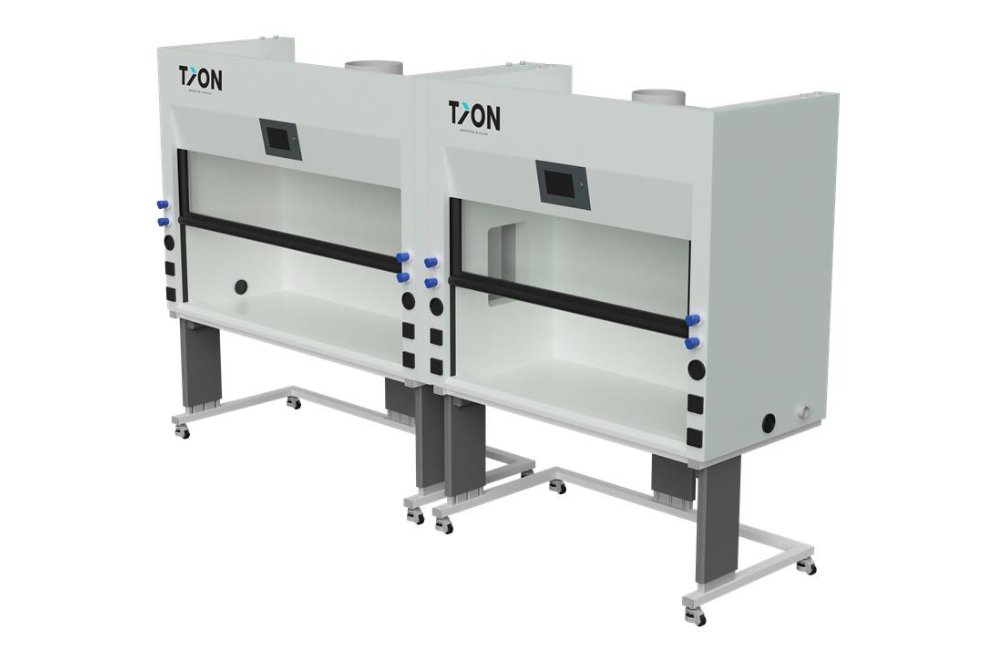
Accessible fume cupboards are becoming an essential consideration for modern laboratories. Since the early 2000's, fume cupboard innovation has fallen flat. What began as an adventurous and vibrant industry has suffered an unfortunate decline. But unlike the American automotive sector in the late 1970s, not all hope is lost. While breakthrough designs have stagnated, accessibility has forced manufacturers to consider a fresh approach. You see, the needs of modern laboratories are changing, and with that change comes new opportunities. Height adjustability, touch screen controls, and voice interaction are driving conversations on accessibility and generating new ideas to reach an otherwise inaccessible audience.
To be clear, the question isn't whether these technologies will add value to fume cupboards, but how. In today's article, we will explore the positive benefits of these systems and discuss the principles that govern their implementation. After all, what good is a height-adjustable stand if you don't know how to use it effectively?
Supermarkets, football stadiums and shopping centres welcome people from all walks of life. They're recreational hubs designed to support the needs of the many and the few. Laboratories are no different. These sites have a moral obligation to support their staff. The University of East Anglia is a great example. The New Science building features accessible toilets, colour-coded directions and elevator access throughout the entire premises. It allows a new generation of enthusiastic scientists to navigate the facility and use its equipment regardless of physical impairments.
But what use is an accessible laboratory if you haven't got the equipment to match? As we all know, fume cupboards are arguably the most important piece of safety equipment inside the lab. They create a vital barrier between toxic fumes and those operating the cabinet. It's a priority for manufacturers like TION to ensure the theme of safety and inclusivity is present in our products. In 2026, we not only need to consider the application the fume cupboard is designed for, but also the people who plan on using it. It needs to be compliant, inclusive and future-proofed. Put bluntly, inclusion is no longer a gimmick. It's a necessity.
So, when we use the term "accessible fume cupboard", what exactly do we mean? Well, the definition of an accessible or height-adjustable fume cupboard in the UK is fairly vague. While BS EN 14175 covers safety, containment and airflow, accessibility is a grey area that receives little to no attention. In America, accessible fume cupboard design is governed by ADA compliance, which includes knee clearance, controls and specialised cabinets. However, while the UK has no clear guidance, the Disability Discrimination Act (DDA) and Equality Act 2010 obligates service providers, employers, and educational institutions to make reasonable adjustments to ensure disabled people can access their facilities and equipment.
If we apply that definition in practical terms, it means height adjustability, voice-activated controls, touch-screen controls, intuitive gestures, sash controls and visual alarms. It should enable wheelchair users, seated operators and those standing upright to use the cabinet regardless of any physical impairments. Now, yes, unfortunately, the technology we're discussing does have its limits. However, the benefits far outweigh the limitations as we're about to discuss.
Selecting an accessible fume cupboard may seem simple until you scratch beneath the surface. You need to view our equipment through the eyes of your technicians. It needs to be ergonomic, safe, and possess enough flexibility to warrant its purchase. After all, accessible fume cupboards are usually more expensive than a traditional fixed cabinet. So, how can you select a fume cupboard that's faithful to accessibility, and what technologies can you use? Let's do some digging.
Here, you need to consider height adjustability during both seated and standing operations, knee clearance, and the accessories (gas taps and plug sockets). But, bear in mind that being seated should only apply to wheelchair users as a general rule. When specifying a height-adjustable fume cupboard, there are two common options: raising the workbench height or raising the fume cupboard's stand height. While the latter's installation process requires more planning, it does offer some key advantages.
By shifting the entire cabinet, you reduce the reach of those needing to access vital components and, more importantly, to operate the control system. However, there are minor drawbacks. If you value aesthetics, this option may prevent you from using infill panels to hide your ductwork. It's also more expensive to implement. On the other hand, raising the workbench height is slightly cheaper and provides more flexibility during installation and integration with surrounding services. Although it can increase the reach required to access controls and services at the rear of the unit.
At TION, our height-adjustable technology raises the entire fume cupboard chamber and the aerofoil to achieve maximum containment. It's a safer solution that mimics traditional ducted hoods. It also eliminates the risk of compromising containment as the baffles and aerofoil remain at a static position in accordance with how the units will have been type tested. If you decide to purchase a fume cupboard with a height-adjustable worktop, you could be sold a walk-in enclosure with a pneumatic bench. Not your ideal scenario.
Now, you may be scratching your head in confusion, wondering how sash design affects accessibility. While the effort required to operate the sash is an obvious choice, visibility is equally important. Making sure your colleagues have a clear line of sight is essential for wheelchair users or those with height difficulties. They need to see and access their equipment safely and be comfortable while doing it. Remember, standing in front of a cabinet for five hours a day is tough, even for seasoned scientists. Next, there's a choice between manual or electronic sashes. Don't fear. Electronic sashes are the clear winner. Just make sure the button placement is easy to reach.
Selecting the right control system could make or break your laboratory. It’s the primary interface between the user and the cabinet, and if it isn’t intuitive, accessible, and responsive, the entire concept of accessibility begins to unravel. Controls should be positioned within easy reach of both seated and standing users, with clear visual feedback that communicates the cabinet’s status at a glance. Touch-screen interfaces can simplify operation, while voice interaction and gesture-based systems are beginning to open new doors for those with limited mobility. Equally important are the alarms themselves. Audible alerts should be supported by clear visual indicators, ensuring that safety warnings are understood regardless of hearing ability or background noise within the laboratory.
Ultimately, height-adjustable fume cupboards are not about ticking a compliance box or showcasing the latest gadgetry. They are about recognising that the modern laboratory is used by a diverse group of people, each with their own physical requirements and working styles. When accessibility is treated as a design principle rather than an afterthought, the result is equipment that is safer, easier to use, and far more resilient to the changing needs of the scientific community. In many ways, accessibility and inclusive laboratory design may prove to be the catalyst that finally reignites innovation in an industry that has spent far too long standing still.
Remember, a fume cupboard is a safety device first and foremost. Accessibility should never compromise the containment of a system. Space planning, face velocity calculations, and user behaviour should all be considered in detail. Now, this may seem excessive, but height adjustability can impact the performance of your fume cupboard. Make sure the unit is at least 1.5 meters clear of any air outlets, 1 meter clear of pedestrian traffic and 3 meters clear of opposing units. The sash should be positioned as low as possible while still allowing you to work comfortably. Usually 500mm.
Meanwhile, the work surface should be positioned to allow the operator to stand comfortably with their face, head, and upper body firmly outside the sash plane. Equipment and materials should be 150 mm (6 inches) inside the hood. For more information, contact your fume cupboard provider or reference BS EN 14175.
As with all new technologies and design concepts, there are some challenges to consider and mistakes to avoid. For example, height-adjustable ducted fume cupboards require flexiduct and Broen UniFlex piping for the services. Ceiling heights are also a common issue. Setting a maximum and minimum height on the stand will stop your cabinet from hitting the roof or the floor. It's about being practical. Don't design for one user profile only, don't assume that "lower means more accessible", and start your planning from day one. Retrofitting a cabinet to be accessible is easier said than done.
Specifying an accessible fume cupboard should never be a one-person mission. It requires input from a wide range of stakeholders, each bringing a slightly different perspective to the table. Architects and laboratory designers will worry about space planning and integration. Estates teams will be thinking about maintenance, services, and whether the cabinet will try to punch a hole through the ceiling when the stand rises. Health and safety professionals will focus on containment, compliance and user behaviour. And, of course, the manufacturer should be involved early to make sure the ideas being discussed are actually achievable in the real world.
But perhaps the most important voices in the room are the people who will use the cabinet every day. Technicians, researchers and students understand the small frustrations that never appear on a drawing set. They know which controls are awkward to reach, which alarms get ignored, and which “clever” design features become a nuisance after the third hour of use. If you really want to design an accessible fume cupboard, invite them to the conversation. Because nothing humbles a beautifully crafted specification faster than a scientist in a lab coat asking, “Yes, but how am I supposed to reach that?”
At TION, accessible fume cupboard design isn't a product line we bolted on as an afterthought. It's a conversation we've been having with laboratory designers, estates teams, and end users for years. Our height-adjustable fume cupboards raise the entire chamber and aerofoil as a single unit, preserving the containment integrity that a worktop-only solution simply can't guarantee. No compromises. No workarounds. Just a cabinet that works as it should, regardless of who's standing in front of it.
If you're specifying an accessible fume cupboard and want to talk through the detail, we're happy to help. Get in touch with our team or share your specification below.
Final Thoughts: Accessible fume cupboards are not a passing trend or a flashy upgrade designed to impress visitors on a laboratory tour. They represent a shift in how we think about the people who use our equipment. For years, fume cupboard design has remained largely unchanged, but accessibility is beginning to challenge that stagnation. Height adjustability, intuitive controls and thoughtful sash design all play a role in making laboratories safer and more inclusive for the people working inside them. Of course, these ideas must be implemented carefully. Accessibility should never compromise containment, safety or practicality. When designed properly, however, accessible fume cupboards deliver something far more valuable than compliance. They create laboratories that work better for everyone. If that process happens to drag fume cupboard innovation out of its two-decade nap, then frankly, it's long overdue.
Read our Privacy Policy for more information on how we collect and process data.



No thank you
Read our Privacy Policy for more information on how we collect and process data.