For decades, architects, engineers, project managers and cost consultants have treated fume cupboard specification as a late-stage procurement item. Why? Because tradition dictates methodology. Or in this case, "If it ain't broke, don't fix it". But what if the system breaks? While fume cupboards lack the influence of ventilation systems or floor plates, they dictate the science. Neglecting the specification of these systems undermines the cost and programme certainty of a project. Allow me to explain.
Unlike centrifuges or autoclaves, ducted fume cupboards integrate with your system architecture. They become part of the building via the design and specification of the laboratory. Think about it. The ceiling heights, air changes and ventilation systems all have an impact on the performance of the unit. In short, these requirements need to be specified early to accommodate the equipment. But if that's the case, then why don't we start the fume cupboard specification process at the same time?
Hear me out. Fume cupboards come in a broad range of sizes. The larger the hood, the greater the demand on the extract system. So, how can you design the HVAC without understanding the science and the type of equipment needed to support it? After all, you wouldn't purchase a sports car with a top speed of 50MPH. So, why would a pharmaceutical company move into a state-of-the-art laboratory that can only accommodate five ducted fume cupboards when they need ten?
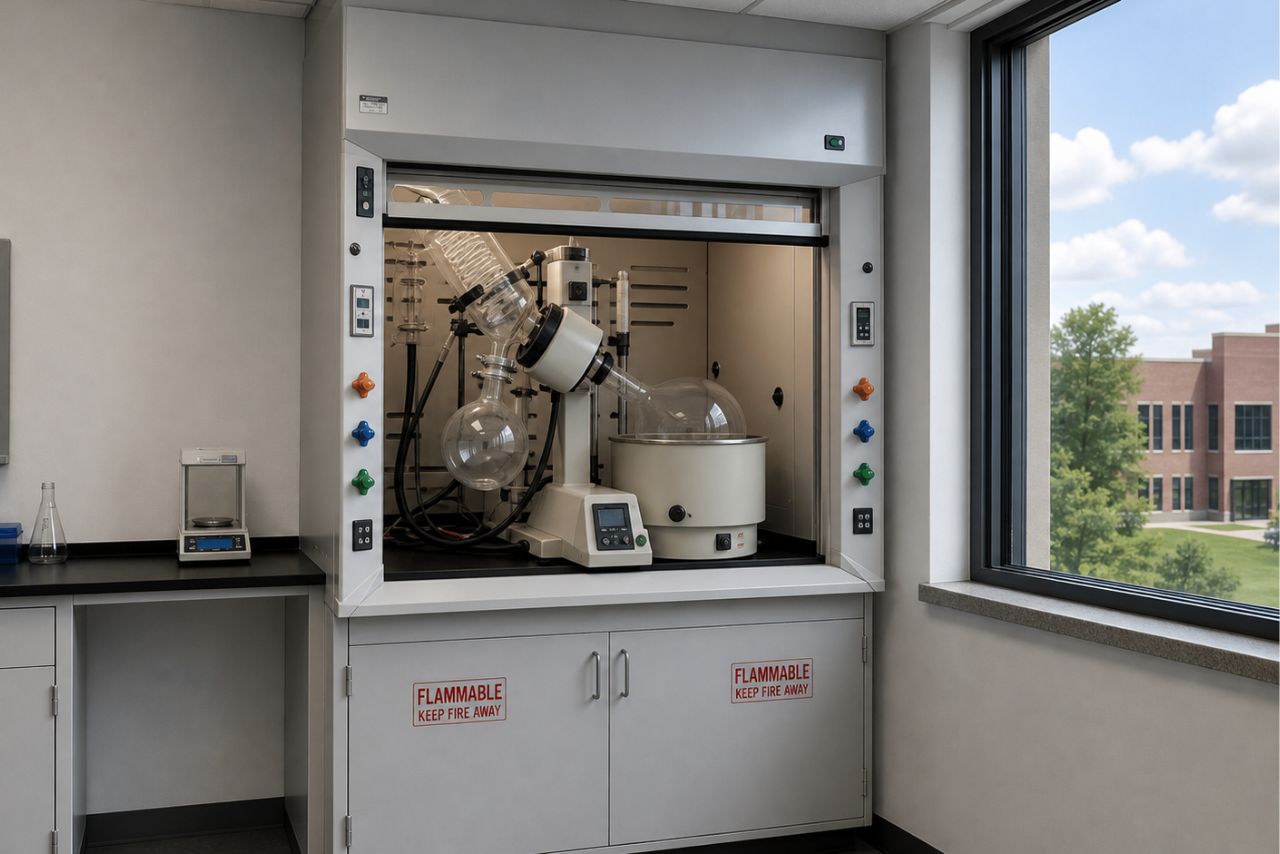
Have they considered the equipment going inside the workspace? What if it's too large like the rotary evaporator pictured above? Do they need a walk-in fume cupboard or a height-adjustable stand? If so, have you considered the impact on the services or the under-bench storage? It's what we refer to as the art of the possible. Understanding the end users' requirements and translating those needs into a viable fume cupboard specification essentially de-risks the project. At TION, our three-stage specification methodology is designed to work alongside project managers, facilities managers, architects and engineers to make this process as seamless as possible.
On the other hand, what happens when the specification is too late or vague? Well, to be blunt, a combination of preventable disasters. The downstream consequences of late-stage decision-making compromise lab design and increase capital costs. It turns the cost management exercise into a laughingstock. Then there’s the mechanical implications to consider. Limitations in make-up air or riser restrictions all have negative consequences that can be fixed by engaging with your fume cupboard supplier early.
Tell me, how does a specification that only lists the dimensions of the unit, product type and stand benefit those tendering for the project or the end user? The variation in cost alone is confusing. With those specifications, I can provide you with two quotes ranging from £5,000 to £25,000 per unit. Again, a pointless exercise. In a worst-case scenario, you may find the solution is unfit for purpose. As one Chief Scientific Officer once quoted, "A fume cupboard that lacks thought is a glorified storage cabinet".
What about gas taps, base cabinets, work surfaces, sinks, power sockets or carcass materials? These costs quickly add up, and while providing the bare minimum may seem like a time-saving exercise, it creates substantial bottlenecks that incur needless cost. “Oh, Aaron, you’re just being pessimistic”. Well, when you’ve worked on hundreds of projects and see the same recurrent issues, pessimism tends to creep in. Sorry about that.
So, when is the best time to specify fume cupboards? In short, RIBA Stage 2-3. Start the process alongside your M&E strategy, ideally before energy modelling and cost plans are finalised. Advocate for collaboration from your estates teams, design consultants, engineers, and management personnel. Turn early-stage fume cupboard specification into best practice. In our experience, it shortens the equipment procurement process by over 30 days (40%) on complex projects. Not only that, it produces a smooth process workflow that creates accountability where it’s needed. Design, manufacturing and delivery deadlines are all accounted for, and, more importantly, the product works as intended.
Our Rothamsted Research case study is a prime example. By understanding the hazards posed by the chemicals on site, perchloric acid, and pre-arranging access through a third-storey window, we worked weeks ahead of schedule. It's proof that early engagement isn't just theory. It leads to greater safety, more predictable outcomes and provides longevity to those who need it most. The end users.
Final Thoughts: Late-stage specification has become the default, not because it works, but because nobody questioned it. The cost of that habit lands on cost consultants chasing variations, project managers absorbing delays, and end users left with equipment that barely does the job.
Early engagement costs nothing but a conversation. A call with your supplier at Stage 2 instead of Stage 4. A specification that asks what the lab actually needs, not just what fits the budget line. Rothamsted proves the model works on projects with genuine complexity and genuine hazard. There's no reason it can't work on yours.
Design forwards. Bring fume cupboard specification into the room early, alongside the M&E strategy, not after it. Programmes hold. Costs stay predictable. And the people working under that extraction system get equipment built for what they're actually doing, not what was easiest to spec six months too late.
That's the difference between designing a lab and assembling one.
Read our Privacy Policy for more information on how we collect and process data.



No thank you
Read our Privacy Policy for more information on how we collect and process data.