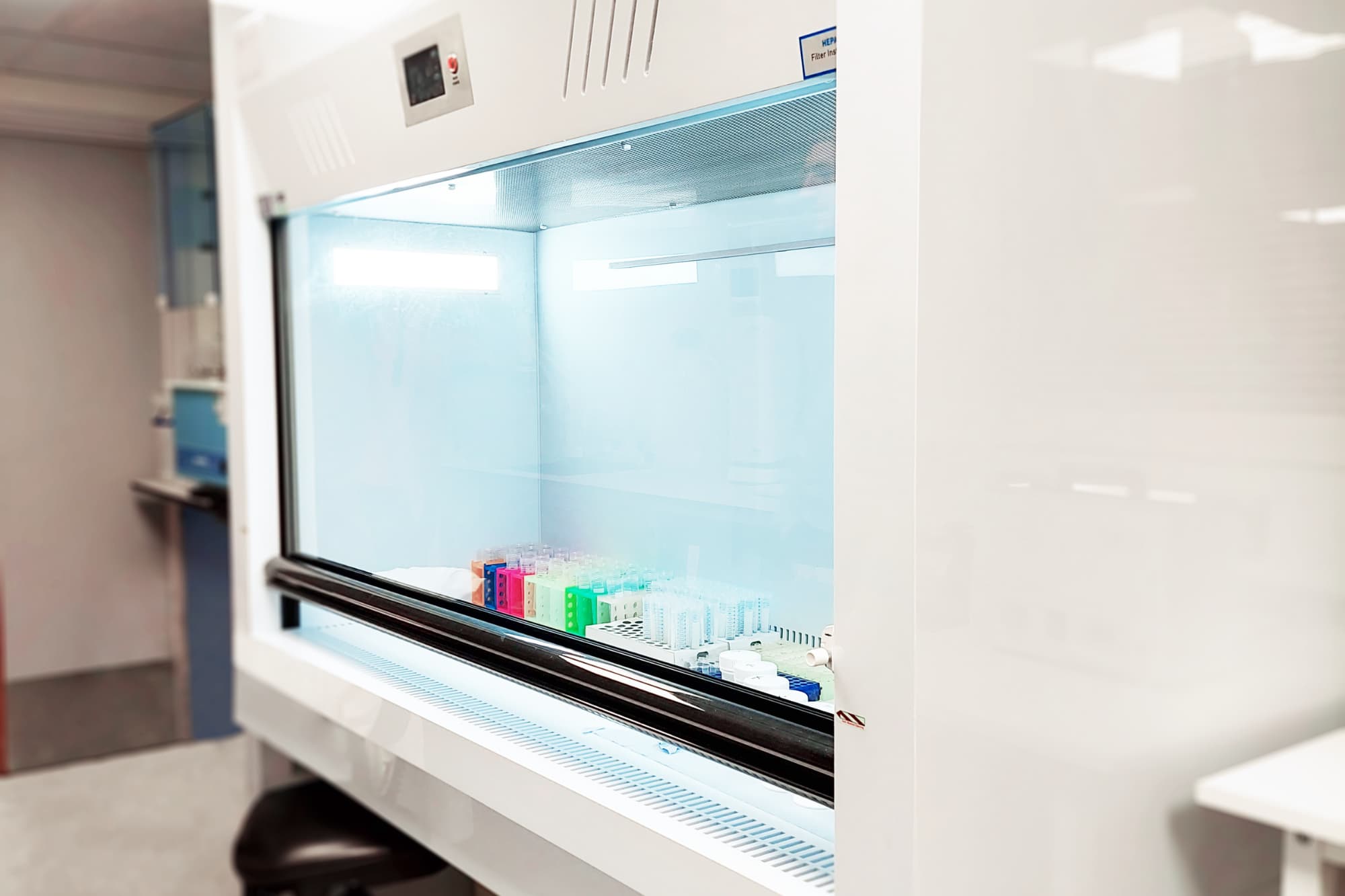
Laminar flow fume cupboards and Class II B2 biosafety cabinets look similar, sit in the same part of a lab, and are often shortlisted side by side. But they're built to protect against very different things. Get the choice wrong, and you either overspend on containment you don't need or under-protect people and samples from a hazard the cabinet was never designed to handle. Which, for the record, isn’t legal or logical.
This guide focuses on the one decision that matters: which of the two you should specify for your application and why. For the fuller breakdown of biosafety cabinet classes (Class I, II A2, II B2 and III), see our guide to Class I and Class II biosafety cabinets. This article assumes you already know roughly what a biosafety cabinet is, how it functions and want help choosing between these two specific options.
So, to start, both cabinet types extract air through the sash, filter it, then direct clean air over the work surface in a non-turbulent, laminar pattern. Aside from visual aesthetics, the cabinets function almost identically. The difference lies in what happens once the air leaves the cabinet. Allow me to explain.
If your work involves anything biological that could be harmful if released, such as cell cultures, clinical samples or infectious agents, the Class II B2 biosafety cabinet is the only appropriate choice of the two. However, if you don’t use biological samples, a laminar flow fume cupboard is worth considering.
| Attributes | Laminar Flow Fume Cupboard | Class II B2 Biosafety Cabinet |
|---|---|---|
| Operator protection | Yes | Yes |
| Sample/product protection | Yes (laminar downflow) | Yes (laminar downflow) |
| Exhaust air HEPA filtered | No — 100% vented unfiltered | Yes — 100% HEPA H14 filtered |
| Safe for biological/pathogenic work | No | Yes |
| Suitable for chemical work that could damage a biosafety cabinet interior | Yes | Not recommended |
| Ducting required | Optional, depending on model | Always — hard-ducted |
| Typical governing standard | BS EN 14175 (closest applicable standard, though not formally certified to it) | BS EN 12469 |
| Best suited to | Chemical handling, trace metal work, general clean-air-plus-extraction tasks | Any work involving biohazards or pathogens |
A word of caution: a Class II biosafety cabinet isn't automatically the "safer" or more capable choice because it protects against biological hazards. For common lab tasks involving acidic chemicals, a laminar flow fume cupboard is a better fit:
Biosafety cabinets are built around stainless steel work surfaces and are designed for biological decontamination, not chemical resistance. If you're working with solvents or chemicals that could corrode or degrade the interior, a laminar flow fume cupboard with a polypropylene or chemical-resistant build is often available as a more durable option.
Biosafety cabinets are built to a fairly fixed specification to meet certification requirements (BS EN 12469). If your application needs something outside of that envelope, for example, a non-standard size, or a bespoke work surface, a laminar flow fume cupboard may give you more design flexibility.
Applications like trace metal analysis require a metal-free internal environment, which some biosafety cabinets can't offer. On the other hand, a laminar flow fume cupboard specified with the right materials can meet that requirement without compromising on airflow cleanliness.
Let's go back to basics. There are some scenarios where traditional fume extraction needs a little sample protection to prevent cross-contamination without a single biological hazard in sight. It also reduces the need for filters on the extract.
There's no substitute here: any work involving biological agents, pathogens or infectious materials MUST be contained inside a Class II biosafety cabinet and not a laminar flow fume cupboard. The HEPA-filtered, hard-ducted exhaust emphasises that point. It's what stops these hazards from leaving the cabinet and contaminating the surrounding area. So, if there's a biological hazard in your application, the decision on what to acquire is already made for you. Simple, right?
It's also worth checking whether you need Class II A2 (recirculating, lower installation cost, no ducting) or B2 (ducted, 100% exhaust). That's covered in full in our Class I and Class II biosafety cabinet guide. B2 is generally specified where volatile or toxic chemicals are used alongside biological material, since A2's recirculation isn't appropriate for that combination.
Class II biosafety cabinets are tested and certified against BS EN 12469. Laminar flow fume cupboards aren't formally certified to a specific British Standard in the same way, but reputable manufacturers design and test against it as the closest relevant benchmark. Whichever you choose, both need regular servicing and re-certification to keep performing as designed. See our guide on how often your fume cupboard needs servicing for typical intervals.
Ready to talk through which option fits your application? Explore our Class II biosafety cabinets or our laminar flow fume cupboards, or get in touch for guidance.
Read our Privacy Policy for more information on how we collect and process data.



No thank you
Read our Privacy Policy for more information on how we collect and process data.