Fume cupboard servicing is one of those things that's easy to overlook until something goes wrong. Like a motorbike or a classic 1950s Chevrolet (yes, I have a fascination with old-school cars), a fume cupboard requires regular testing to confirm it's still doing its job correctly. In this case, that means meeting EN 14175 standards, which define how often your fume cupboard needs servicing and what the test actually involves. So, let's get into the details.
To start with, fume cupboard servicing differs from maintenance or commissioning. Servicing involves testing the containment of a system, while commissioning sets the baseline of a new or modified unit. On the other hand, fume cupboard maintenance is totally different and typically involves planned work, such as replacing parts, modifying systems, or retrofitting.
Using the car analogy, maintenance is like changing worn tyres or replacing a chipped windscreen. In contrast, servicing resembles an annual MOT check, changing the oil, replacing spark plugs, and testing the brakes. Work that your local garage would usually perform. Consequently, missing an MOT could land you in hot water. For fume cupboards, this increases the chance of equipment downtime, failed audits and could compromise the safety of your staff. In pharmaceutical or high-throughput GMP laboratories, this can quickly result in millions of pounds in lost revenue.
EN 14175 is more than just a technical guideline. It supports the legal responsibility of your employers to provide safe working conditions for their staff. In the UK and Europe, EN 14175 reinforces health and safety laws that require controlled exposure to hazardous substances. It also details how to test fume cupboards and what constitutes a pass or a fail. In other words, it defines what “safe” means in actual terms.
If a fume cupboard hasn’t been serviced or tested according to EN standards, proving compliance becomes challenging or even impossible. Like an MOT for a car, the cupboard may still function, but it’s no longer legally compliant. What EN 14175 does offer is consistency and traceability to the compliance process. With standard test methods, documented results, and fixed service intervals, you can measure performance over time. Regulators, insurers, and quality control teams depend on this evidence to demonstrate compliance and manage risk. In short, EN 14175 prevents fume cupboard safety from being a subjective gut feeling into an objective process.
Scientists often describe fume cupboards as fit-and-forget pieces of equipment. They're not. By law, a fume cupboard must be serviced at least once every 14 months. You can schedule tests at your convenience, so long as you meet the 14-month minimum requirement. Remember, in busy labs with high usage and complex chemical environments, performance can degrade quickly. Just because a fume cupboard passed a service test last year, that does not mean the product is still safe to use today.
The annual service is not just a formality either; it is designed to keep your lab safe. Airflow, containment, alarms, and mechanical parts are all checked against strict standards. You can opt for a service every six months if you deem it necessary. It’s about defining a common-sense approach. If the cupboard is noisy or the airflow drops, do a quick visual check or call a service engineer. If everything looks good, you can stick to your regular service schedule.
Fume cupboard servicing should only be carried out by a competent person. In practice, that means someone with the technical knowledge, equipment, and experience to test a fume cupboard against EN 14175 standards and interpret the results accurately. It is not a job for a general facilities contractor or an in-house maintenance team unless they have specific training in laboratory containment testing.
The recognised qualification to look for is the BOHS P601, a proficiency certificate issued by the British Occupational Hygiene Society that covers the thorough examination and testing of LEV systems. While it is not a legal requirement, the HSE strongly recommends it, and in practice it has become the benchmark for competence in this area. In regulated environments such as pharmaceutical or GMP laboratories, your quality team will likely have specific requirements around engineer qualifications and report format, so it is worth checking those before you book.
Fume cupboard servicing costs vary depending on the number of cabinets, their type, your location, and the scope of the visit. A straightforward annual service on a single ducted fume cupboard will cost less than a multi-cabinet visit involving variable air volume systems or tracer gas containment testing.
The honest answer is that cost should be a secondary consideration. A missed or inadequate service creates far bigger problems down the line, whether that's a failed audit, equipment downtime, or a safety incident. The more useful question is what you're getting for your money: qualified engineers, EN 14175 compliant testing, and documentation you can actually rely on.
There are three tests that a service engineer will perform when they visit your site, although SF6 is a specific request that's usually performed offsite as part of the cabinet commissioning process:
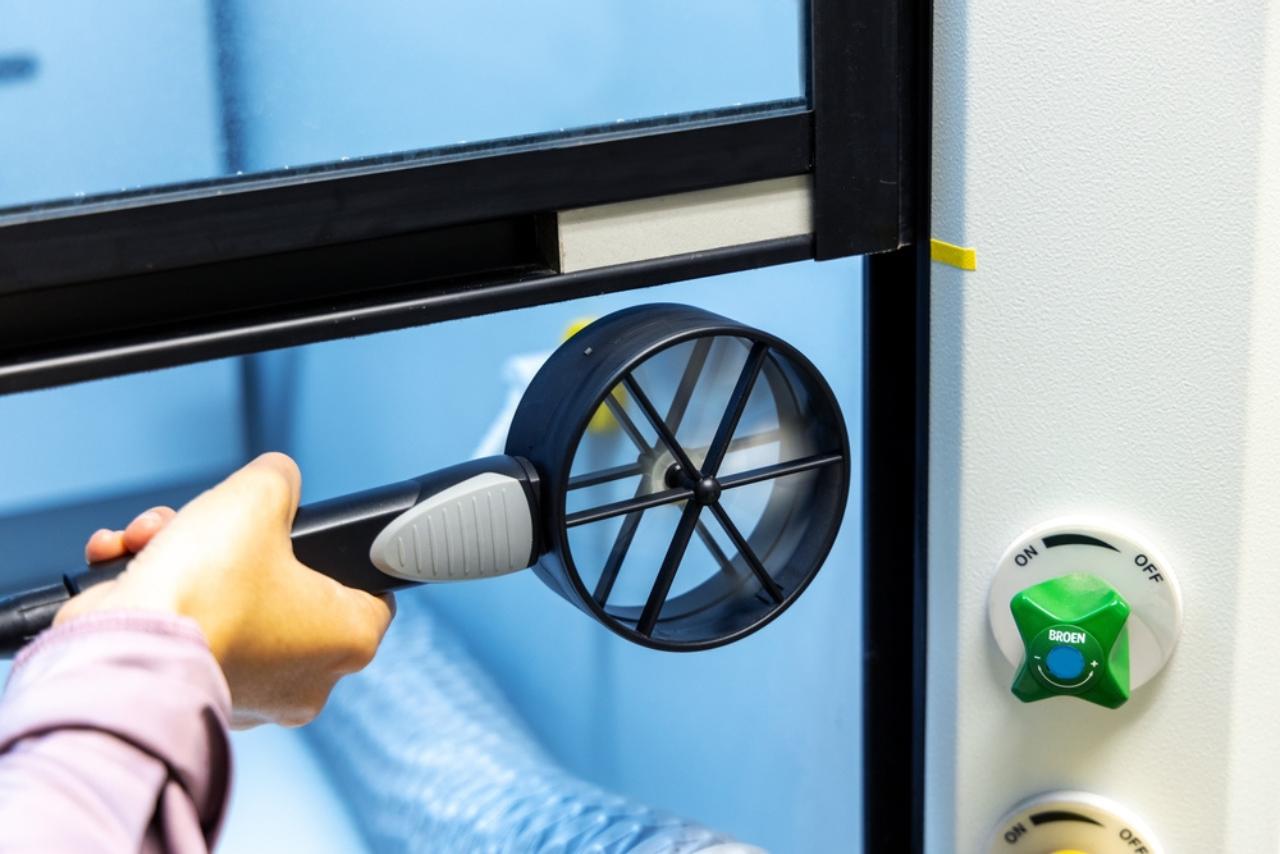
This test determines the face velocity of the cabinet at various sampling points. A thermal or vane anemometer will measure air speed across the face of the fume cupboard in a grid pattern to obtain an average reading. The industry standard is 0.5 m/s with a 500mm sash working height.
If you have a variable air volume fume cupboard, the sash is measured at three different points: fully open, 50% open and 25% open to ensure the system is fully functional. The test also checks for uneven airflow, dead spots and turbulence across the sash opening. Even if the average face velocity looks acceptable, a dead spot could allow fumes to escape into the lab.
A smoke pattern visualisation test makes airflow visible to the naked eye. The engineer releases a harmless, non-toxic smoke around the sash opening to reveal turbulence, reverse airflow and leakages. It's a test that essentially simulates lived working conditions to see how the airflow responds. For example, if the smoke swirls inside the workspace, that's a clear indication of turbulence that could compromise containment. Keep in mind that, unlike the face velocity test, smoke pattern visualisation maps the direction of the airflow, not the speed.
Tracer gas containment is an off-site factory acceptance test that measures the effectiveness of a fume cupboard to contain hazardous fumes. It releases SF₆ at a controlled rate from a diffuser positioned inside the cabinet, usually near the work surface. Similar to the smoke pattern visualisation test, it enables engineers to monitor leaks from the cabinet.
The difference comes from the use of gas sensors to detect trace elements inside the room. These trace elements are compared against a strict pass/fail criterion defined in EN 14175. Low or non-detectible readings indicate good containment, while elevated readings indicate the reverse.
Documentation and compliance records are the first line of defence when protecting the health and safety of your staff. They prove your fume cupboards are functioning correctly and demonstrate your due diligence. Without this documentation, you're relying on assumptions rather than facts. In well-regulated environments, that's a weak excuse and a vulnerable position to be in. While skipping a service might seem convenient, health and safety audits and inspections will root out poor working practices.
On the other hand, good working practices allow performance tracking over time. By comparing historical data, facilities managers can spot gradual declines before they compromise containment. Regulators expect this level of traceability, and for good reason. Clear, consistent documentation turns fume cupboard safety into a legislative practice.
At TION, we carry out fume cupboard servicing for laboratories across the UK. Whether you're booking an annual service, responding to a failed test, or simply trying to get ahead of your next inspection, our engineers work to EN 14175 standards and back every visit with full documentation, giving you a clear, auditable record from the moment we leave site.
If you'd like to book a service visit or talk through your requirements, get in touch with our team and we'll take it from there.
Final thoughts: If you plan on purchasing a fume cupboard, servicing is a necessity, not a luxury. After all, fume cupboards aren’t fit-and-forget pieces of equipment. They are sensitive health and safety devices designed to support your staff in their operations. It requires maintenance, training and regular health checks to ensure it still functions correctly. So, take a common-sense approach and book in your service visits early. As Benjamin Franklin once said, “An ounce of prevention is worth a pound of cure.”
Read our Privacy Policy for more information on how we collect and process data.



No thank you
Read our Privacy Policy for more information on how we collect and process data.