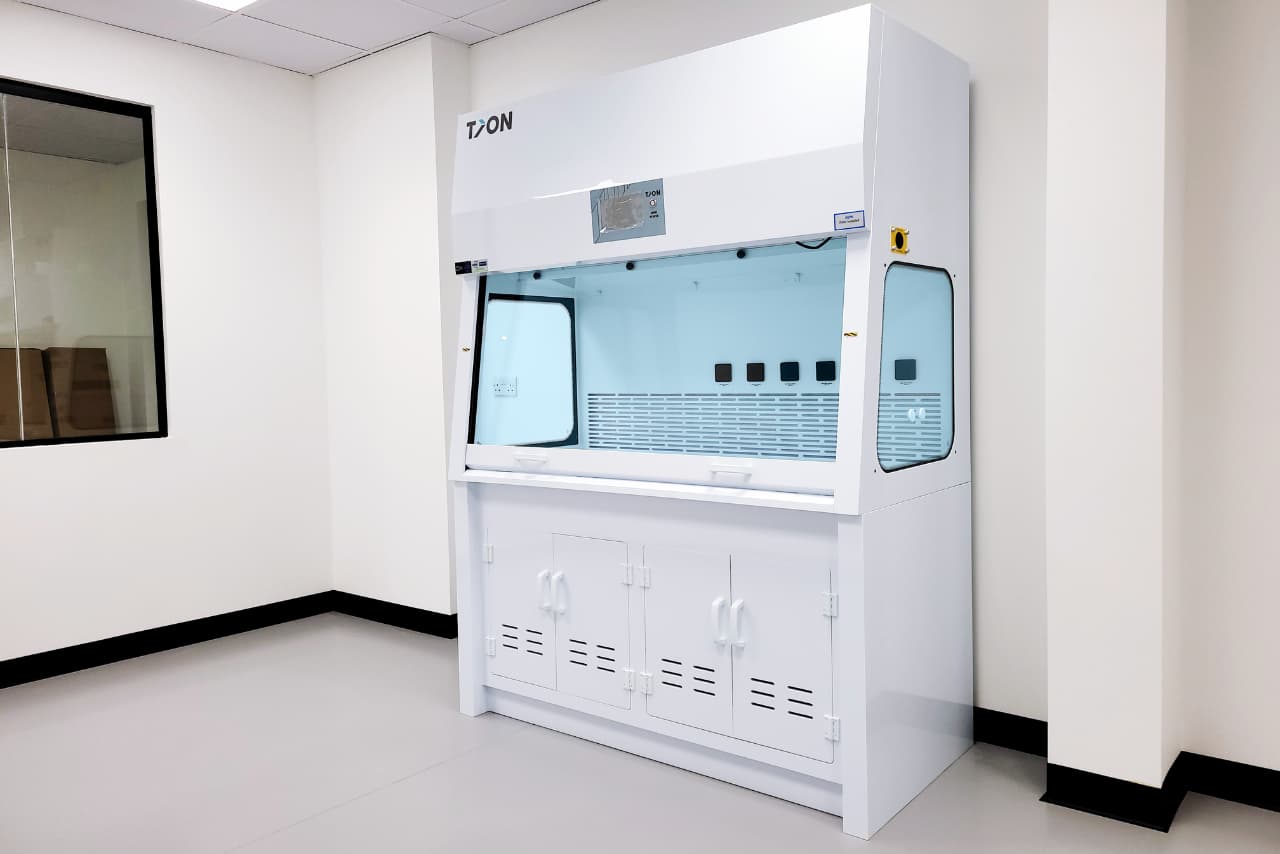
Choosing the right fume cupboard for your laboratory can be a challenge. So, understanding how they function and the type of science they're capable of supporting is an essential first step in your selection process. It just so happens that ductless fume cupboards occupy a thinly veiled line between convenience and application versatility. Having context on where this line begins and ends will save you time, expense, and the occasional outburst in rage (not for the faint-hearted).
So, let's start with the basics. A ductless fume cupboard is a self-contained ventilation device designed to extract hazardous fumes from the workspace. It achieves this through the use of a HEPA or ULPA filter, then recirculates air back into the lab. Coincidentally, this is why your scientific colleagues may often refer to ductless fume cupboards as recirculating or self-contained hoods if you want to be especially cool.
Removing ductwork from the equation allows for an enormous level of flexibility. It simplifies the installation process, lowers costs, and transforms the cabinet into a plug-and-play system. Come to think of it, it's no different from a standing cooker or a microwave, minus the incentivising "ping" after the meal is cooked. However, there are several factors to consider when selecting the right cabinet. Which leads us to our next topic. The type of chemicals you plan on using inside your fume cupboard.
Arguably, the biggest drawback to ductless fume cupboards is the applications or materials they're capable of supporting. Remember, a HEPA filter is made from randomly arranged fibres (fibreglass), or synthetic materials like polyester or polyamide. In short, it's prone to saturation and can become damaged quickly.
With this in mind, ductless fume cupboards are only suitable for low-volume applications. Think quality control, forensics or inert manufacturing processes. Strong corrosive acids like sulfuric, fluoroantimonic, or hydrofluoric should be avoided at all costs. Unless you enjoy the sound of dissolving filters, that is. The health and safety of your employees should be a top priority, so the chemicals you're using will be the deciding factor in whether a ductless fume cupboard is right for you.
A ductless fume cupboard is a recirculating system, meaning air travels through a filter, then gets recirculated back into the lab. Therefore, having adequate ceiling heights to prevent airflow restrictions is a necessity. We recommend at least 30 cm. So, think about the height and width of the unit before you buy it. This measurement also applies to the sides of the unit to prevent turbulence inside the workspace.
Beyond simple dimensions, think about how the fume cupboard will interact with your surrounding environment. Review doorways, nearby equipment or foot traffic, as well as maintenance access. A well-planned layout not only enhances airflow performance but also makes day-to-day operation safer, smoother, and more efficient.
Let's face it. Cash is king, and fume cupboards are expensive. However, asking whether a recirculating fume cupboard is cheaper than its ducted counterpart is simple. The answer is yes. Considerably cheaper when you factor in the installation costs. For example, if a benchtop ducted fume cupboard costs £10,000, you can expect to pay 50% less for a ductless model of similar size and specification. In this case, £5,000.
The only drawback is the filters, which need to be replaced at timed intervals depending on the volume and frequency of your application. This is why we recommend contacting your equipment provider to ensure the solution is fit for purpose. After all, who wants a fume cupboard with filter replacements every two months?
Modern laboratories are embracing modular furniture, equipment, and designs to increase the flexibility and scope of their spaces. It makes sense considering the demands of tenants in a speculative lab, or even for established end-users. Thanks to its plug-and-play setup, ductless fume cupboards complement this model well. While yes, ductless fume cupboards need to be recommissioned after each move, the installation cost is £0. This gives operators the chance to work at their full capacity without being constrained by the design of your lab.
On the other hand, a ducted unit is permanently fixed in place and offers no flexibility. These tend to be installed in older buildings or facilities with limited access. If you decide to relocate, decommissioning and removing these units also comes with a high cost. Just remember, while ductless fume cupboards may seem like a winning system, you're limited to the number and volume of chemicals you can use. It's comparable to the annoying brother-in-law in an otherwise functional and happy family.
Remember, a filtered fume cupboard requires slightly more care and maintenance than a ducted system. Setting regular alarms that monitor filter saturation, booking DOP tests and replacing those filters is a necessity. Also, understanding how the airflow sensor, face velocity, sash and control system functions should be a top priority. You will need to make sure that someone inside your laboratory is responsible for managing these processes. This includes ordering new filter replacements.
There are advantages and disadvantages of both ductless and ducted fume cupboards, and it is essential to understand both before deciding which is right for your laboratory. The usage of different chemicals, upfront and ongoing costs, and availability of staff are all important factors to consider when choosing the right unit for you.
For more information and to discuss your requirements in detail, contact our specialists today. Alternatively, you can purchase our ductless fume cupboards by clicking the link.
Read our Privacy Policy for more information on how we collect and process data.



No thank you
Read our Privacy Policy for more information on how we collect and process data.