For years, ductless fume cabinets occupied an uncomfortable grey area in laboratory safety. While ducted units had EN 14175, a robust and internationally recognised framework covering everything from containment performance to commissioning, ductless units? They had BS 7989, a British Standard that predated smartphones, the Human Genome Project, and the first series of Big Brother. It did the job. Briefly, but the laboratory sector had long since moved on, and this relic of a bygone era hadn't kept pace.
That changed in November 2025 when the British and European Standards Committee for laboratory furniture and equipment published BS EN 17242, the first dedicated European standard for recirculating fume cabinets. Which essentially means there's a new sheriff in town, and for anyone specifying, purchasing, or managing ductless containment systems, a new set of standards to follow.
BS EN 17242 is the British and European standard for ductless (recirculating) fume cabinets. It replaced BS 7989 on the 30th November 2025. It sets new rules for construction, filter classification, monitoring, type testing and on site testing. While it applies to new units, existing units are not automatically affected, but they still deserve a review.
So, for those unfamiliar with the standards, BS 7989 was introduced in 2001 as a British Standard covering filtration fume cupboards and cabinets. During that time, it was a reasonable attempt to govern a low priority, albeit neglected, category of equipment that didn't fit into the ducted fume cupboard framework. You see, in the early 2000s, filtered units were a niche product, largely confined to educational settings and buildings where ductwork wasn't practical.
Twenty years on, the landscape looks very different. Ductless fume cabinets have become a credible option for many pharmaceutical, research, and industrial environments, not just sixth-form chemistry classrooms. The chemicals handled are more complex, the regulatory environment is more demanding, and performance expectations have risen sharply. Originally, BS 7989 wasn't written with any of that in mind. Its withdrawal in November 2025 wasn't a surprise. What took longer was the arrival of a more comprehensive and robust framework.
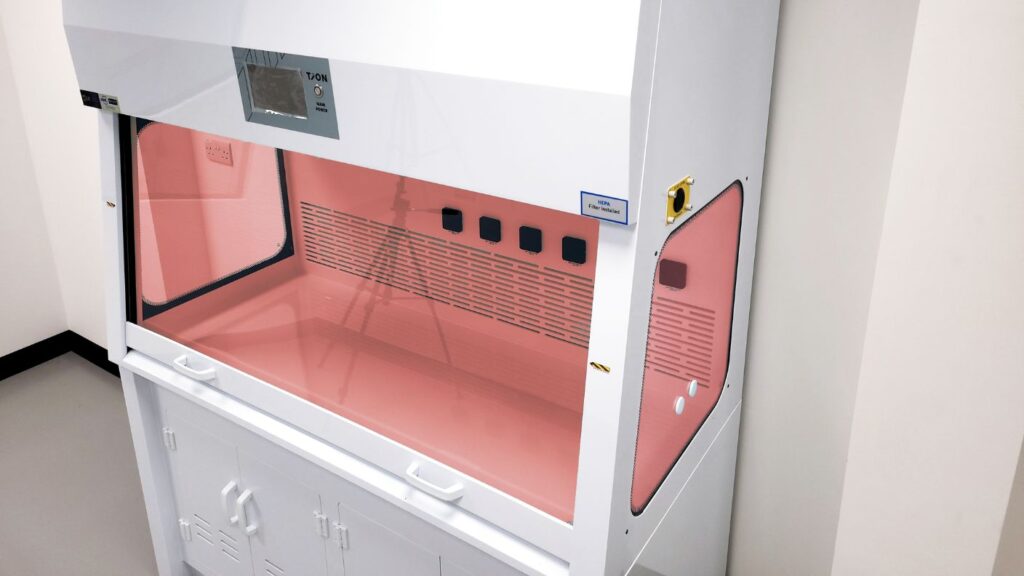
BS EN 17242 is the new British and European Standard for recirculating filtration fume cabinets. It sets out requirements for cabinet construction, classification, filtration systems, and type testing as well as on site testing. Crucially, it applies to new recirculating units installed from November 2025 onwards by aligning ductless technology with the same rigour expected of ducted equipment under EN 14175.
The "EN" designation is significant. Unlike BS 7989, which was a purely British standard, BS EN 17242 is the UK version of EN 17242:2025. That is a European Norm prepared by the CEN technical committee CEN/TC 332. National standards bodies across Europe, including BSI, are bound to adopt it. BSI published it on the 30th November 2025, and it formally supersedes BS 7989:2001. That matters for manufacturers, specifiers, and end users operating across borders, and it also signals that ductless fume cabinets will no longer be treated as the junior sibling of ducted units.
The scope is tight, so it doesn't cover ducted fume cupboards, which stay under EN 14175. It also doesn't cover microbiological safety cabinets either. Those fall under EN 12469. So, to be clear, your biosafety cabinets are unaffected.
| Area | BS 7989:2001 | BS EN 17242:2025 |
|---|---|---|
| Status | Withdrawn November 2025 | Current |
| Reach | UK only | European Norm, adopted in the UK and across CEN members |
| Name for the unit | Filtration fume cupboard | Recirculatory filtration fume cabinet |
| Classification | No standard code | X/Y/Z code for filter arrangement, filtration type and monitoring |
| Filter information | Broad guidance | Compatible chemical list from the filter supplier, shown on the cabinet front |
| Filter checks | Less emphasis on monitoring | Continuous monitoring, or sampling ports either side of the filter |
The most meaningful changes lie in five key areas: terminology, classification, filter performance, testing requirements, and the information provided to end users.
Since the introduction of BS EN 17242, recirculating units must now be referred to as fume cabinets, not cupboards, although the term ductless fume cupboard is still widely used. The standard's formal name is recirculatory filtration fume cabinet, or RFFC. This provides a clear distinction between the two product ranges and simplifies classification of the systems. Since the early 2000s, those terms have been interchangeable. But gone are the days of the never-ending fume cupboard/fume cabinet debacle.
This is the most practical change for specifiers. Every cabinet now carries a three part code. Each part answers one question.
| Part | What it tells you | Options |
|---|---|---|
| X | Where the filters sit | A = built in B = associated or external |
| Y | What the filters remove | 1 = particulates (HEPA) 2 = gases and vapours (activated carbon) 3 = both 4 = other filtration devices |
| Z | Whether continuous monitoring is fitted | 0 = not fitted 1 = fitted |
So an A/2/1 cabinet has a built in carbon filter with continuous monitoring. An A/3/0 cabinet has built in carbon and HEPA filtration, but relies on sampling ports instead of monitoring. The code lets you compare suppliers like for like. It also gives your COSHH assessment something concrete to check against.
Under BS 7989, filter guidance was relatively broad. However, BS EN 17242 introduces clearer expectations around how filtration systems are classified, how they must be tested, and how performance data should be communicated. That last point is particularly important. One of the long-standing criticisms of ductless fume cupboards is the lack of information available on which chemicals are safe to use with different filters. Now, filter suppliers must make this information readily available. It must also be displayed on the front of the cabinet. It must be updated whenever the filter is replaced. While BS EN 17242 begins to address that gap, it also aims to provide end-users with enough information to make a confident decision on which filter to use inside their cabinet.
Continuous monitoring now has a formal place in the standard. Where it is fitted, it detects chemical breakthrough at the filter outlet and triggers an alarm. This safety feature goes far beyond measuring the lifespan of a carbon or HEPA filter, instead focusing on its current performance. Where it is not fitted, the unit must have sampling ports on both sides of the filter. These let you connect portable gas detection equipment and check filter integrity yourself.
Type testing is also strengthened. Manufacturers must demonstrate that their ductless cabinets meet defined performance criteria under controlled conditions. For buyers, this provides a clearer basis for comparison and a stronger foundation for risk assessment. It goes beyond asserting compliance on the basis of a decades-old design standard. Instead, it focuses on providing actionable insights.
Think of it this way: would you buy a car whose safety rating was based on a crash test from 2001, using methods that predate modern side-impact protection? Probably not. The same logic applies here.
The standard splits testing into two parts.
Filtration testing shows how long a filter is likely to last. A challenge gas is released inside the cabinet at a steady rate. Concentrations downstream of the filter are monitored throughout, and when they start to rise, the filter has reached a breakthrough. An on site test is different. It confirms the filter works today, but it cannot tell you how much life it has left.
On the other hand, containment testing checks that fumes stay inside the cabinet during use. Ducted fume cupboards are tested under EN 14175 using SF₆ as a tracer gas. That doesn't work here. SF₆ has a very high global warming potential and can't be removed by filtration. So BS EN 17242 uses isopropyl alcohol (IPA) instead.
There's just one caveat. There is no published correlation between IPA and SF₆ results yet. The British Standard's own foreword notes this. So you can't compare a ductless containment figure directly with a ducted one.
This is where pharmaceutical and research labs need to pay close attention.
BS EN 17242 does not set requirements for mixtures of chemicals. It gives guidance on how to approach them instead. That's important, because a filter rated for each chemical on its own may not behave the same way with a mixture.
The standard also flags carcinogenic, mutagenic and reprotoxic (CMR) substances. It notes that local regulations can apply to them, and those regulations may restrict their use in a recirculating cabinet.
In practice, that means three things.
In many of these cases, a ducted fume cupboard remains the safer route.
This is the question most laboratory managers will ask first, and the answer is straightforward. BS EN 17242 applies to new recirculating fume cupboards installed from November 2025 onwards. Units already in service are not automatically required to meet the new standard.
That said, it would be unwise to treat existing units as entirely outside the picture. If your current ductless fume cupboards were purchased and specified against BS 7989, which is now withdrawn, the question of ongoing safety assurance becomes more pressing. Regular COSHH testing, filter monitoring, and documented risk assessments remain essential regardless of what standard a unit was originally built to. The new standard provides a useful benchmark against which to evaluate whether your existing equipment still meets the expectations of a modern laboratory environment.
If your ductless cupboards are ageing, under-specified, or approaching the end of their service life, now is a reasonable time to revisit the specification with fresh eyes.
Specifying a compliant ductless fume cabinet under BS EN 17242 requires a more considered approach than simply ordering off a brochure. There are several practical steps worth taking.
First, ask your supplier directly whether their recirculating units are designed and type tested to BS EN 17242. Many manufacturers' units are still built to BS 7989, which is now obsolete. That isn't automatically disqualifying for all applications, but it is a conversation worth having before you commit. As Albert Einstein once said, "If I had an hour to solve a problem, I would spend 55 minutes defining the problem and only five minutes finding the solution".
Second, pay close attention to filtration classification. BS EN 17242 introduces structured requirements around how filters are categorised and what they are certified to handle. Ask for the X/Y/Z code in writing. For example, a carbon filter described loosely as "suitable for solvents" is not the same as a filter that meets the classification criteria of the new standard. So, push for specifics. The standard is designed to accommodate detail. Asking for that detail early on will improve your compliance and avoid costly mistakes.
Third, think carefully about the chemicals being used. No single filter type will handle every substance safely, and no recirculating fume cabinet should be treated as a universal containment solution. Your COSHH assessment should drive the specification, not the other way around. If you have unanswered questions on the specification of your equipment, speak to your supplier, or talk to us.
Finally, involve your health and safety team early. The introduction of a new standard is a natural trigger for reviewing your containment strategy more broadly. Not only that, but it's also a good opportunity to audit your existing ductless inventory, revisit your COSHH assessments, and ask whether the equipment currently in your lab is still the right equipment for the work being done inside it.
At TION, recirculating fume cupboards are part of a wider containment offer that includes ducted units, walk-in enclosures, laminar flow systems, and bespoke solutions for pharmaceutical and chemical environments. Our work with GSK, Novo Nordisk, Novartis and the University of Oxford has given us a clear understanding of how standards change the specification of a system, not just on paper, but in practice. This is especially true in pharmaceutical GMP environments, where attention to detail matters and the scientific application is protected at all costs.
The arrival of BS EN 17242 is a positive development for the sector. It raises the specification baseline, improves the quality of information available to end users, and brings ductless equipment closer to the level of scrutiny applied to ducted fume cupboards for the past two decades. That can only be a good thing for those who want to use the cabinets, and those in positions of authority charged with making the equipment functional and safe.
If you're specifying a ductless fume cabinet or managing a project that requires these systems, and want to discuss how BS EN 17242 works in more detail, our team would be happy to help. Get in touch or share your specification by emailing us at support@tion.co.uk.
Here are some FAQs we typically get asked:
It is the British and European standard for ductless (recirculating) fume cabinets. It covers construction, classification, filtration, monitoring, type and on site testing.
It is not law. But it is the current recognised standard, and specifications and tenders will expect it for new units. COSHH still requires adequate control of exposure whatever standard a unit meets.
Not automatically. The standard applies to new units. Keep testing existing units under COSHH, and use BS EN 17242 as a benchmark when they come up for review.
A built in filter (A), gas and vapour filtration such as activated carbon (2), and continuous monitoring fitted (1).
The standard notes that local regulations may restrict this. Your COSHH assessment should decide. In many cases, a ducted fume cupboard is the safer option.
SF₆ has a very high global warming potential and cannot be filtered out. IPA can, so it suits a recirculating cabinet.
Final Thoughts: BS EN 17242 is a long overdue update to existing ductless standards. The ductless fume cabinet market has matured significantly since BS 7989, and the old standard had been running on borrowed time for years. The new framework raises expectations around filter classification, type testing, and user information in ways that will benefit specifiers, end users, and manufacturers who take quality seriously. For laboratories reviewing their containment equipment in 2026 and beyond, this is the standard to build against.
Read our Privacy Policy for more information on how we collect and process data.



No thank you
Read our Privacy Policy for more information on how we collect and process data.